

Northern Ireland’s planning system remains one of the most significant barriers to delivering renewable electricity at the pace required to meet legally binding climate targets. In this Policy Unpacked post, Policy Analyst Madeleine Clarke break down the key insights from RenewableNI’s recent seminar on planning reform, examining how decision‑making timelines, policy delays, and gaps in strategic direction continue to slow renewable energy development across Northern Ireland.
From prolonged planning decision times and delays to the Renewable Electricity Price Guarantee (REPG), to the limitations of the revised Strategic Planning Policy Statement (SPPS), this analysis explores where progress has been made and where opportunities have been missed.
Timelines
Recent data published by the Northern Ireland Assembly (‘Planning Decision Times – comparison across the UK and Ireland’) shows during the period April 2024 – March 2025, planning decisions consistently took longer than statutory targets. Northern Ireland’s processes are slower than in neighbouring jurisdictions. While the average processing time for major applications is at its lowest since 2015, it is still over the statutory 30-week target.
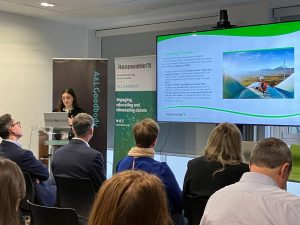
Madeleine Clarke, RenewableNI Policy Analyst, presenting at Planning and NI Renewable Electricity seminar
RenewableNI welcomed the publication of the revised SPPS and the Final Design of the REPG last year. The delays in the publication of these key documents have delayed the development of renewables in Northern Ireland.
If there are further delays in the introduction of the REPG legislation and the launch of the consultation on terms and conditions, the first auction will not take place in 2027. This will seriously impact Northern Ireland’s ability to reach its statutory 80 per cent renewables by 2030 target.
Strategic Planning Policy Statement Edition 2
While there are positive changes in the revised SPPS, it was a missed opportunity for a much stronger and more ambitious policy. Key points identified by RenewableNI are:
“Appropriate weight”
The revised SPPS states planning authorities must give “appropriate weight” to climate targets. Stronger language would give a stronger policy signal in support of renewables. Giving climate targets “significant weight” would have much more positive impact.
Local Development Plans
Local Development Plans (LDPs) must be updated in line with the revised SPPS. However, several Plan Strategies have already been published in accordance with the old SPPS. A time bound pathway should be introduced for when planning authorities should update their LDPs. There should also be clarity on the hierarchy between local and regional policy. This will prevent confusion and delay in decision-making.
Five-Year Review Cycle
The revised SPPS currently has a five-year review cycle. This means 2030 will have passed before the SPPS is next reviewed. To ensure the SPPS has its intended effect of expanding renewables, an annual review cycle should be introduced. Necessary changes could then be made in time to meet the 2030 target.
Wind Energy
The change from a 10 times rotor diameter separation for wind farms to assessing rotor diameter separation on a case-by-case basis is a very welcome change for wind farm developers. It removes a key barrier to the construction of wind energy projects.
Solar Energy
The preference for solar to be developed on brownfield sites has been dropped from the draft SPPS Edition 2. This would have seriously restricted solar developments. Solar is to be promoted on appropriate countryside locations, which is more positive language for the industry.
Renewables training for planners
One of the problems raised, in RenewableNI’s planning working group and during the seminar Q&A panel, was planners’ lack of knowledge and understanding of the renewable sector.
RenewableNI is currently working with the Department for Infrastructure (DfI) and the Royal Town Planning Institute (RTPI) to deliver two days of training for planners, covering renewable technologies, the developer journey, and legal issues faced by the industry. DfI is currently also carrying out a Planning Improvement Programme and Trainee Planner Programme. These actions should improve the efficiency and capacity of the planning system.
Climate law has teeth, says planning lawyer
Climate law is starting to have real impact in Northern Ireland and neighbouring jurisdictions.
In Northern Ireland, the High Court judgement on the upgrade to the A5 road confirmed government decisions must align with climate targets. In the Republic of Ireland, the Supreme Court decision on the Coolglass Wind Farm confirmed public bodies must prioritise climate targets in decision-making. This shows the direction of travel across the island of Ireland is towards climate law having real strength and impact.
What this means for renewable electricity in Northern Ireland
While there have been some positive steps forward in the Northern Ireland planning system, it still acts as a barrier to renewable electricity development. The SPPS was a missed opportunity to set a much stronger policy agenda in favour of renewables. An annual review cycle should be introduced to ensure the SPPS has its intended impact of expanding renewable energy.
Timelines must not slip on introducing the REPG to the Assembly so the first auction can take place as early as possible in 2027.
You can hear more about these issues is Smart Energy on Thursday 26 March.
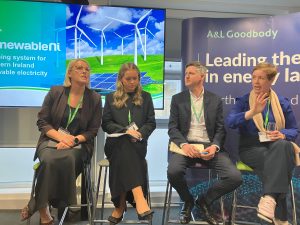
Thank you to (l-r) Micaela Diver and Cara Hughes, A&L Goodbody; Ryan McBirney, Strategic Power, and Sara Tinsley, Energia Group, for presenting and participating in the Q&A panel.
You can view all the presentations only.

