

In this edition of Policy Unpacked, Judith Rance explores why Renewable Electricity Price Guarantee (REPG) is a turning point for Northern Ireland’s energy system. As costs rise and demand for clean, secure power grows, REPG has the potential to reduce bills, strengthen energy security and unlock renewable investment.
Northern Ireland stands at a pivotal moment in its energy transition.
Northern Ireland has one of the strongest wind resources in Europe. We have an experienced and capable renewables industry, a strong pipeline of projects, and capital ready to invest.
What we have lacked, for almost a decade, is the policy framework needed to unlock that potential.
The Renewable Electricity Price Guarantee (REPG) scheme, being developed by the Department for the Economy (DfE), offers the chance to put that framework in place at last.
Missed opportunity for renewables
Since the Northern Ireland Renewables Obligation (NIRO) closed in 2018, progress has slowed significantly.
At its peak in 2022, renewables supplied more than 51 per cent of Northern Ireland’s electricity. That figure has now fallen to 47 per cent, a continued downward trend and now includes bioenergy and energy not generated in NI.
Over the past seven years, just 109MW of large-scale renewable capacity has been delivered, compared to 400MW in 2016 alone.
Renewable rewards
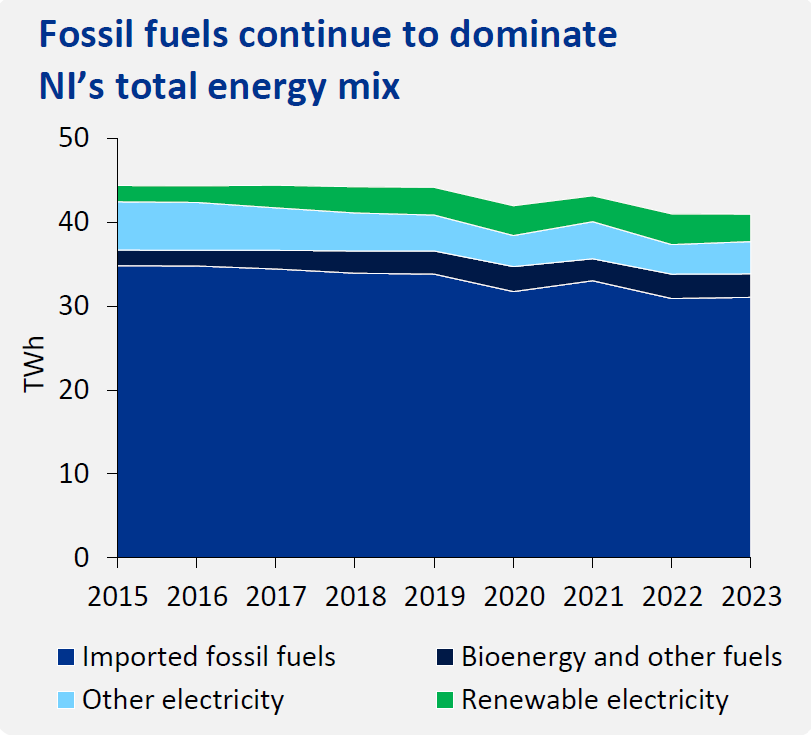
Renewable electricity is already reducing bills, cutting carbon, supporting jobs and improving energy security in Northern Ireland. It is helping shift the region away from reliance on imported fossil fuels and towards a more stable, affordable and locally powered energy system.
In 2025 alone, renewable electricity avoided £219 million in gas and carbon costs. Since 2022, renewable generation has helped retain over £1 billion locally that would otherwise have been spent on fossil fuel imports.
Domestic renewables have insulated families and communities from spiralling fuel costs, cutting bills by an average of £160 per person between 2020 and 2023. Baringa analysis shows renewables could unlock additional savings of £110 million in 2030. [Renewable Rewards report]
Our Energy Security – Supporting the Renewable Electricity Price Guarantee report shows that meeting 80 per cent renewable electricity consumption by 2030 could contribute £479 million in Gross Value Added each year and support significant employment across the onshore wind and solar supply chains.
In an increasingly volatile geopolitical environment, energy policy is no longer just about decarbonisation. It is about resilience, consumer protection and national security.
What is REPG?
The Renewable Electricity Price Guarantee (REPG) is a proposed support scheme being developed by the Department for the Economy (DfE).
REPG is designed to restore long term price stability and investor confidence in Northern Ireland’s electricity system. Providing fixed-price contracts for renewable projects will help shield consumers from volatile fossil fuel prices while supporting the deployment of clean, domestically generated electricity.
REPG will restore confidence in the market, unlock private investment, protect consumers, create skilled jobs and support Northern Ireland in meeting climate targets.
Do other countries have support schemes?
The introduction of the Contracts for Difference (CfD) scheme in the UK and Renewable Electricity Support Scheme (RESS) in RoI has seen them unlock their renewable potential. The five RESS auctions supported €12.5 billion renewable investment, adding 6,000MW of renewable capacity.
 As well as GB and RoI, many other jurisdictions are using, or are planning to use, schemes similar to REPG, for example:
- Spain: Introduced a two-way, fixed-price scheme in 2020.
- France: Uses a two-way scheme for offshore wind.
- Denmark: Moved from earlier models to a two-way system for 2024/2025 offshore wind projects.
- Netherlands: Implementing a two-way support scheme by 2027.
How REPG will work?
REPG is modelled on the renewable energy support schemes currently operating and proven in GB and RoI and incorporates learnings and best practices from these schemes.
REPG will establish a predictable, long-term investment pipeline of renewable energy supply through scheduled auctions and revenue certainty.
Renewable energy projects which secure a contract will receive a 15-year, inflation linked offtake contract, which will establish a fixed-price benchmark for a portion of electricity supply, reducing exposure to wholesale price volatility.
For consumers, REPG stabilises electricity costs and delivers bill protection during periods of high wholesale prices. It incorporates consumer-friendly elements:
It will use auctions to secure the most competitive renewable electricity prices for consumers. Only the most cost-effective projects will secure contracts.
The scheme is funded through a system-level levy on electricity bills. When wholesale market prices are below the contracted price, the levy contributes to scheme costs; when prices are above the contracted price, generators pay back into the system, resulting in bill rebates for consumers.
A Narrow Window for Action
Primary legislation is required in 2026, with the first auction expected in 2027. With the Assembly window limited, the opportunity to progress REPG in this mandate is time critical.
If the legislation does not pass by then, Northern Ireland could miss this vital window of opportunity.
The REPG represents private investment, consumer protection and long term energy stability. It is the mechanism that can move Northern Ireland from uncertainty to delivery.
Northern Ireland has the resources, the industry and the ambition. What NI needs now is delivery.
Time is not a renewable resource. The industry is ready. Let’s deliver.

