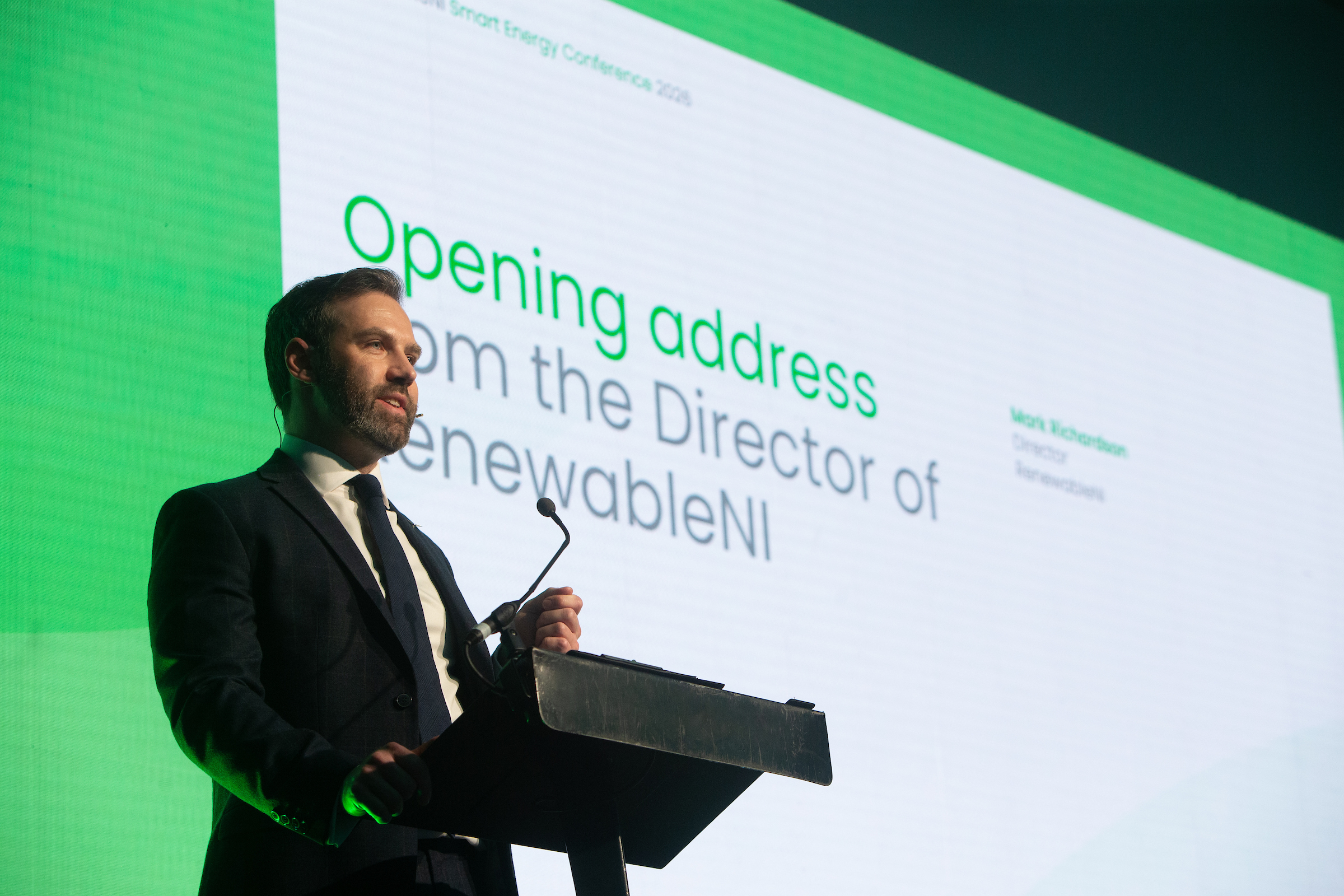
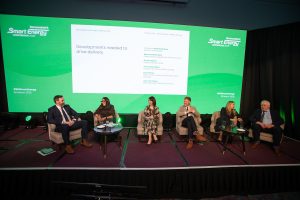
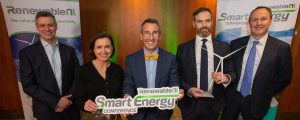
Mark Richardson, RenewableNI Director opened this year’s Smart Energy conference setting out the importance of REPG and the need to act at pace.
In my first 100 days, I’ve seen both the scale of the opportunity and the cost of delay. The next twelve months will define the direction of renewable energy in Northern Ireland for the next ten years and beyond.
The decisions taken, or not taken, between today and this time next year will either unlock a decade of investment, jobs, environmental protections and genuine energy security, or Northern Ireland will lose out. As I see it, there is no middle ground.
In recent days and weeks, consumers have once again watched energy prices spike due to the war of unintended consequences. The reality of yet another conflict is surging through global markets and landing, as it always does, on the bills of families and businesses who bear the costs without having any say.
Over the last decade, households and businesses have endured too many shocks. Gas is priced globally, regardless of where it comes from. We are exposed, and the exposure is getting worse.
Which is why a clear conclusion is now shared well beyond the energy sector:
Energy security is national security.
Decentralised renewable energy is significantly more resilient than gas, faster to restore after disruption, and insulated from the kind of global market volatility that continues to drive consumer bills. For Northern Ireland, a renewables-led system offers more stable costs for consumers, a stronger electricity market and a more competitive environment for inward investment.
In other words, supporting renewable energy is not just an environmental choice.
It is a defence choice.
It is an economic security choice.
It is the right choice for Northern Ireland.
Today isn’t just about what the renewable energy sector CAN do; it’s also about what we’re ALREADY doing.
Since 2022, renewable electricity has kept over £1.1 billion in Northern Ireland that would otherwise have flowed out to international gas markets. Last year alone, £219 million was saved. Renewables have done more than any other industry to hold down the cost of electricity.
And yet renewable electricity generation now accounts for just 47 per cent of gross final consumption. That’s significantly below the peak of 51 per cent in 2022. Four years ago.
That reduction isn’t because the wind stopped blowing or the sun stopped shining.
It’s because the policy framework needed to unlock new investment has not been delivered.
As a sector, we are being asked to sprint while dragging a parachute.
As we look to the critical decisions to be taken over the coming months, the Renewable Electricity Price Guarantee (REPG) is the most consequential.
 It will mean Northern Ireland has a proven mechanism similar to those that have resulted in billions of pounds of investment across Great Britain and enabled the Republic of Ireland to double its wind energy capacity in the last 10 years.
REPG means energy security.
REPG means private investment.
REPG means jobs, community benefit funds and lower exposure to volatile gas prices.
Above all else, it means national security.
The final design has been published by the Department for the Economy, and I want to welcome and acknowledge that.
However, faith has been damaged by consistently missed deadlines, eroding confidence.
REPG terms and conditions are overdue, and the Bill still needs to pass through the Assembly in this mandate.
With 400 days until the election, the window is closing fast. Unfortunately, time is not a renewable resource.
We are competing with Ireland and Great Britain for the same pool of investment. Both have functioning support schemes. Both are actively courting the capital we need.
The message from this conference is unambiguous: pass the REPG Bill, on time, and deliver the first auction without delay.
The industry is ready. We need government to be ready too. It’s time to make up for lost ground.
Our members will create the renewable energy Northern Ireland needs, but we must deploy the grid to move it from where it’s generated to where it is used.
NIE Networks’ RP7 business plan commits £2.23 billion to network investment, and SONI has set out clear ambitions for the transmission grid. We welcome both.
But our members’ lived experience on connections, timelines and certainty does not always align with the public narrative.
Key projects have slipped by years. Despite the introduction of the Joint Project Management Office, SONI’s draft Transmission Development Plan, published in October 2025, acknowledged further delays to grid delivery timelines for almost all projects.
This has damaged industry confidence and trust.
This is not about blame or trading accusations. If there are ways our members industry can engage better or work more collaboratively to ease the process, we are open to that.
But the gap between rhetoric and delivery MUST close.
The timelines for grid and REPG delivery must align.
Northern Ireland consumers are depending on new wind, solar and battery projects. Not just for stability, but for national security. Let’s work together to get them built and connected.
On planning, some progress has been made, and we recognise that. But the system remains one of the most significant barriers to deployment. Too often, delay arises within the statutory consultee process.
We are not asking for corners to be cut. We are asking for statutory timelines to be met, for a properly resourced system, and for a planning culture that recognises delay has environmental and climate costs as well as economic ones.
Our industry is committed to engaging earlier and working constructively with planners and environmental bodies. We ask for the same in return. We’ve seen this approach deliver. RenewableNI has recently partnered with the Department for Infrastructure and RTPI, for example, to deliver the first of multiple Renewable Energy Training workshops for planners.
This transition is not just about carbon. It is also about nature. Climate change and biodiversity loss are twin crises. Done right, renewables can protect habitats, enhance biodiversity and support sustainable land use, but delay risks locking in continued fossil fuel dependency, with far greater environmental harm.
Get things right, and by the end of 2026, Northern Ireland’s renewable energy sector will be in its most promising position in years.
New projects will move from development towards construction.
Families and businesses who are struggling to keep pace with every energy price hikes will look forward to more stability in their energy bills.
Our local coffee shops, bars, manufacturers and employers can plan ahead with certainty and confidence.
Northern Ireland can be more secure, less exposed, and less dependent on decisions made in capitals and commodity markets far beyond our control.
For our children and grandchildren, energy security is national security.
We believe in these benefits. We believe we are in a unique position to create opportunities across Northern Ireland. We believe it is our job to win the trust of people who are concerned about wind farms – offshore and onshore – solar parks and energy storage projects.
We’ll keep investing in consultation and engagement, researching and developing modern techniques and practices to minimise impact. But most importantly, listening.
To those of you here today in positions of influence, if I can respectfully make three requests:
- Progress and pass the REPG Bill.
- Deliver on grid development.
- Establish planning as an enabler, not a blocker.
These are not partisan asks. They are economic, environmental and security asks.
To investors: We know your confidence in Northern Ireland depends on policy certainty. We are leaving no stone unturned to achieve that.
To our members: keep building, keep engaging, keep pushing. Let’s step outside our comfort zones. And where we can do things differently or collaborate better, let’s do that too. Above all else, keep delivering, and at RenewableNI, we’ll keep supporting you.
And finally to everyone in this room:
- Energy security is national security.
- Clean energy is economic security.
- And Northern Ireland’s renewable energy is generational security.
Let’s get on with it.
Thank you
Want to discuss topics in this speech? Email Mark Richardson

Smart Energy Strategic Event Partner

Smart Energy 2026 Sponsor